The short answer
Not quite. A building survey is a general condition assessment of a property. Building pathology is a defect-specific investigation that goes deeper into a particular problem. A pathology instruction is often commissioned after a survey, valuation or managing agent has flagged a defect such as damp, cracking or a leak that needs a proper diagnosis.
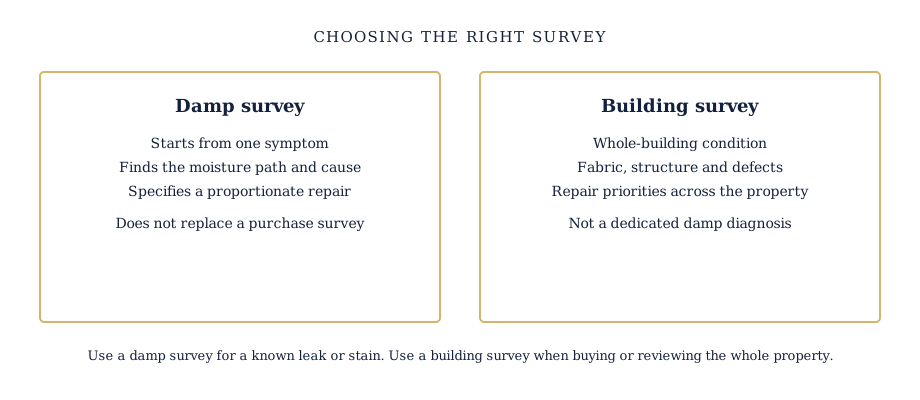
Start with the decision and symptom: a whole-building question points to a survey, while an unresolved moisture problem may need targeted pathology.
Key considerations
Damp surveys
Diagnosis of condensation, penetrating damp, rising damp claims and moisture pathways.
Period property defects
Advice on heritage fabric, breathable materials, timber decay and inappropriate past repairs.
From a damp finding to an investigation brief
Use the existing survey to identify the affected part of the building and what still needs to be established.
Record why further investigation was recommended, when it is needed and which type of specialist the report identifies.
Note any concealed areas or access restrictions, and agree the access required with the owner before further investigation.
Moisture-meter readings and the material being tested
RICS says damp meters are accurate for timber; in other substrates, they may register high readings from other conductive materials, not just moisture.
Its advice is to be wary of anyone relying on a meter alone.
Where further evidence may be needed
Will the report tell me how to fix the defect?
Yes. Once the cause is established, the report sets out a proportionate remedial strategy: what to do, why, in what sequence and what to avoid. Where firm costs or detailed design are needed, we identify where a contractor quotation, structural engineer or other specialist is the right next step.
Turning the answer into a next step
Do you investigate defects in period and listed buildings?
Yes. Period and listed buildings are a core part of this work. We consider breathable construction, historic materials, past inappropriate repairs and conservation constraints, and we flag where listed building consent or specialist conservation input is relevant before remedial work is specified.
What to do next
Consider the symptom, building history and previous repairs.
Choose broad condition advice or defect-specific diagnosis.
Investigate moisture evidence, fabric, ventilation and external defects.
Use opening-up or specialist input only where the diagnostic question requires it.
London area guides
Related services
Sources and standards
Related questions
What is building pathology?
Building pathology is the forensic study of why building defects occur, rather than just listing visible symptoms. It looks at the building fabric, construction, environmental conditions, history and previous repairs to establish the underlying cause of a defect, so the right remedy can be specified and money is not wasted on the wrong treatment.
Do you carry out damp surveys in London?
Yes. We investigate damp by considering moisture evidence, the building fabric, ventilation and occupancy, external defects and the construction type. We separate condensation, penetrating damp and genuine rising damp claims, because each has a very different and proportionate remedy, and we avoid recommending unnecessary chemical treatment.
Do you carry out opening-up works directly?
Under a building-pathology appointment we specify, and where agreed observe, diagnostic opening-up; the physical work is undertaken under a separate contractor appointment so responsibility, method, insurance and reinstatement are clear. Any later group works quotation with sister practice Hampstead Renovations is optional and subject to a role-conflict review. We scope opening-up so it answers the diagnostic question without unnecessary cost or damage.
Related guidance
Local Level 3 building survey guides
Savas Bulduk
BSc (Hons) MRICS, Director & Chartered Building Surveyor.
Writes on Building surveying, Fire safety and facade, External wall systems, Technical due diligence, Contract administration. See the full team profile.
Ask about Building Pathology
Building safety & leasehold briefings
Request building safety and leasehold briefing updates from Hampstead Chartered Surveyors & Building Consultancy.