EWS1 and FRAEW serve different audiences and answer different questions
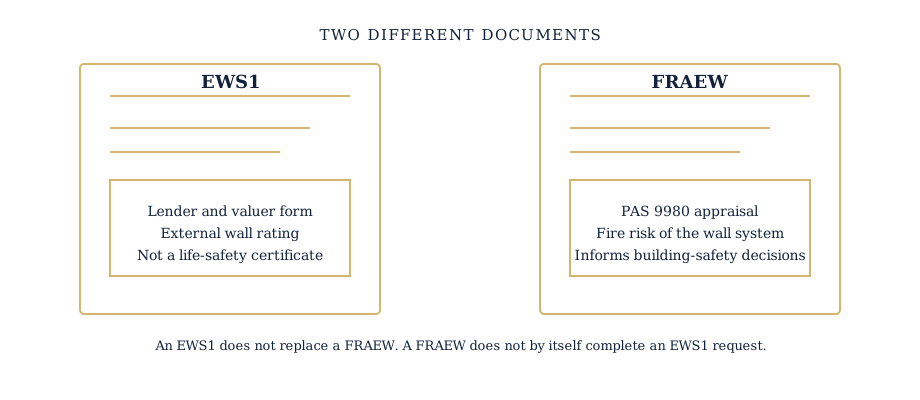
EWS1 - the External Wall Fire Review form - is a lender-facing document that tells a mortgage valuer whether an external wall system has been assessed and what the assessment found. It is not a life-safety certificate and does not replace any statutory fire risk assessment duty.
FRAEW - Fire Risk Appraisal of External Walls - is the technical assessment methodology described in PAS 9980:2026. A FRAEW examines the external wall construction in detail, considers the materials, cavity barriers, balcony detailing and other features that affect fire risk, and produces a risk rating that supports remediation or mitigation decisions.
Put simply: a FRAEW is the technical work; an EWS1 is one of the lender-facing outputs that may follow it. Many EWS1 forms are now informed by a FRAEW carried out under PAS 9980, but not every FRAEW results in an EWS1 form, and not every EWS1 conclusion requires a full FRAEW.
What an EWS1 form is, who can sign it, and what the ratings mean
RICS describes EWS1 as a way for a building owner to confirm to lenders and valuers that the external wall system has been assessed by a suitably qualified professional. The form is signed by that professional and shared with the building owner, who can then provide it to lenders, valuers and prospective buyers.
The EWS1 form has five outcomes, not urgency grades. A1 means no significant combustible attachments; A2 means an appropriate attachment assessment confirms no remedial works are required; A3 means neither A1 nor A2 applies and attachment works may carry potential costs. With combustible wall materials, B1 means no remedial works are required and B2 means remedial works are required.
Common misunderstandings: EWS1 is NOT a life-safety certificate, NOT a fire risk assessment under the Regulatory Reform (Fire Safety) Order 2005, and NOT a Building Safety Act safety case. It is specifically and only a lender / valuer-facing document used in mortgage and re-mortgage decisions.
What a FRAEW assessment under PAS 9980 actually involves
PAS 9980:2026 - the British Standards Institution's Publicly Available Specification - sets out a structured methodology for appraising fire risk in external wall construction on multi-storey residential buildings. It is the British standard reference for this work.
A FRAEW following PAS 9980 typically considers the cladding system make-up, insulation, cavity barriers, fire-stopping at compartmentation lines, balcony construction, escape strategy, building height and occupant profile. The assessment may include desktop review of construction information, on-site visual inspection, and intrusive opening-up where the information is not otherwise available.
The output is a risk rating (low, medium tolerable, medium intolerable, high) supported by reasoning. Where a medium intolerable or high rating is given, the report should also describe what mitigation or remediation would change the rating - so the building owner has a clear path forward rather than only a problem statement.
Five practical differences in a single table
1. Audience: EWS1 is for lenders and valuers. FRAEW is for the building owner / accountable person, the fire engineer if appointed, and any remediation team.
2. Format: EWS1 is a one-page form. FRAEW is a detailed technical report (commonly 30-80 pages on a multi-block instruction).
3. Methodology: EWS1 references the assessment that supports it. FRAEW IS the assessment, applying the PAS 9980 methodology.
4. Who signs: EWS1 is signed by a 'suitably qualified professional' as defined by RICS guidance. FRAEW is signed by a competent professional applying PAS 9980 - typically a chartered building surveyor, fire engineer or similarly qualified specialist.
5. Legal context: EWS1 is industry guidance, not legislation. FRAEW supports duties under the Fire Safety Order, the Building Safety Act regime for higher-risk buildings, and lender requirements.
How to decide which one your building requires
If a lender or valuer is requesting documentation as part of a mortgage application, the immediate need is an EWS1. The professional preparing the EWS1 will commonly need to carry out (or rely upon) a FRAEW to support the form, depending on the building.
An AP must assess and manage building-safety risks in the parts for which it is responsible and provide relevant evidence to the PAP. Whether that evidence needs a PAS 9980 FRAEW depends on the building and the external-wall question; an EWS1 alone is not a Building Safety Act safety case report.
If you are a managing agent or freeholder being asked by leaseholders or buyers about external wall safety, the right answer depends on the building. A short audit of what has already been done - planning records, historic remediation work, available construction information - usually points to whether a FRAEW, an EWS1, or both is the appropriate next step.
Questions visitors commonly ask
Does every flat sale need an EWS1?
No. Whether an EWS1 is requested depends on the building, the lender, the valuer and the building height. EWS1 was originally focused on buildings over 18 metres and has subsequently been applied more flexibly. Some buildings do not need EWS1 at all.
Can the same firm prepare both the FRAEW and the EWS1?
Yes, where the firm holds the appropriate competence for both. PAS 9980 names the qualifications expected for a FRAEW author; RICS guidance describes who can sign an EWS1. Many buildings benefit from one professional doing both so the documentation is consistent.
What does a B1 rating actually mean?
B1 means combustible materials are present but the assessor considers the fire risk sufficiently low that no remedial works are required. B2 means the fire risk is sufficiently high that remedial works are required. Neither outcome determines urgency, interim measures or whether the building can remain occupied.
Is a FRAEW always required for the Building Safety Act safety case?
No. The PAP prepares the report using the building-specific assessments and measures supplied by all APs. A PAS 9980 FRAEW may provide relevant external-wall evidence, but whether one is needed depends on the building and the evidence already available.
How long does each take?
An EWS1 can be issued quickly if the supporting assessment already exists. A FRAEW typically takes 4-12 weeks depending on the building size, available construction information and any intrusive opening-up required.
Where this usually links to live instructions
FRAEW / PAS 9980 London
Fire risk appraisal of external walls under the PAS 9980 methodology.
View FRAEW / PAS 9980 LondonEWS1 Form & External Wall Advice London
EWS1 process support for lender enquiries and external wall reviews.
View EWS1 Form & External Wall Advice LondonFire Safety & Facade Consultants London
Parent service combining FRAEW, EWS1, cladding remediation, compartmentation and BSA support.
View Fire Safety & Facade Consultants LondonResidential Blocks & Freeholders
Fire safety and external wall advice for freeholders and resident management companies.
View Residential Blocks & FreeholdersPrimary sources and further reading
Links checked 18 July 2026. These primary sources provide general context; a competent specialist should confirm how the guidance applies to the building concerned.
You may also find useful
Local Level 3 building survey guides
Savas Bulduk
BSc (Hons) MRICS, Director & Chartered Building Surveyor.
Writes on Building surveying, Fire safety and facade, External wall systems, Technical due diligence, Contract administration. See the full team profile.